

Written by Hans Koomen
The title refers to an old Heinz tomato ketchup bottle commercial where a couple tries to squeeze the last bit out of the bottle, and the voiceover says, "Why not another ketchup?"
The couple then replies, "Which other one?" This came to mind when I rewatched the thirty-year-old Gewest tot Gewest episode about LPR on YouTube. This episode mentions several student court dance associations, but which ones are they? Time to don my miner's clothes again and descend back into Delpher.
Watch "our" fragment in the Episode of Van Gewest tot Gewest here.
I struck gold immediately, because what do we read in Het Rotterdamsch Parool issue of October 30, 1963? On Wednesday evening, November 6, 1963, on the KRO television program T.V.-dansant, our association is giving a demonstration of the Viennese waltz. So our appearance in the 1996 episode of Gewest tot Gewest was not our first TV performance, as was thought at the time!
Of course, we already know one club, and that is Les Gais Galants from Groningen. They ensured that on April 10, 1967, we could read in the Nieuwsblad van het Noorden that "Les Gais Galants danced the best classical dances." The article described a dance competition on the afternoon of Saturday April 8, in honor of the fourteenth anniversary of Albertus Magnus. During this competition, Terpsichoré from Utrecht came in second while we, LPR, came in third, Syndicat d'Initiative Artistique from Leiden took last place.
Sources: Het Rotterdamsch parool, Les Gais Galants and Nieuwsblad van het Noorden.

One of the competing dance pairs from Les Gais Galants.
Well, look at that: two new names of Roman Catholic associations from north of the rivers! Let's do a quick Google search. Unfortunately, there's not much to be found about the Syndicat d'Initiative Artistique from Leiden, other than that it was part of L.V.V.S. Augustinus. Through the website of Erfgoed Leiden en Omstreken, we learn that, in addition to dance, the organisation also engaged in theatrical exploits. It must have been founded around 1960-61, as we read an article about their second lustrum in 1971 and one about their third lustrum in 1976.
Source: Wikipedia: L.V.V.S. Augustinus.
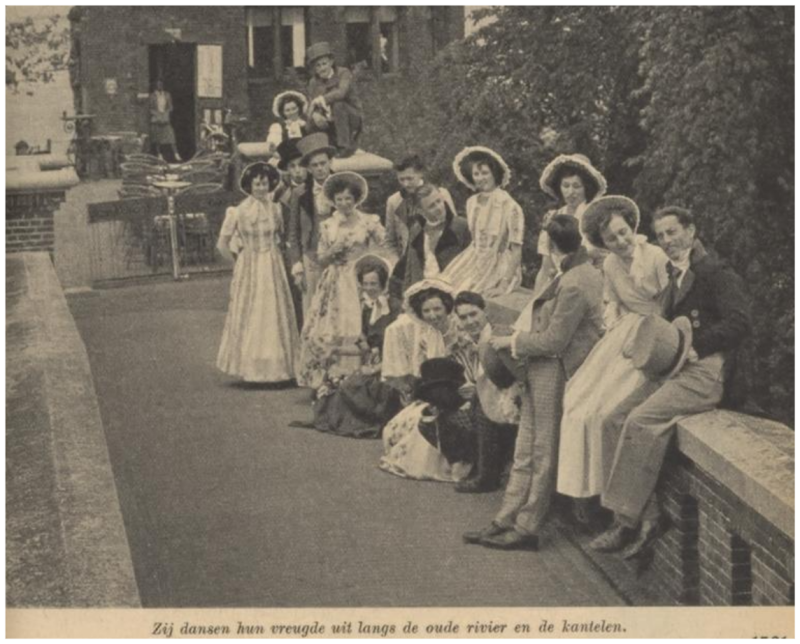
LPR in the Valkhof park. Source: Beatrijs 24, 1952.
For Terpsichoré, or more accurately, Chamber of Dance Terpsichoré (Cabinet de Danse), we must look in the Catholic weekly magazine for women Beatrijs, issue 24 of 1952. In the article titled And the youth dances on, we read that this group won the dance competition in 1951. This is because Utrecht had, successfully it seems, primarily focused on improving its technical skills. As always, Nijmegen was more focused on the element of play. We are ridicule, after all!
The group is part of Collegium Studiosorum Veritas in Utrecht. In the Utrecht Archives, we find the following description:
The Chamber, also referred to as the classical dance company Terpsichoré, emerged from the Dance Committee, established in January 1946, which was dedicated to organising the dance performance on July 17 of that year in Wilhelmina Park as part of the celebration of the 62nd lustrum of Utrecht University. The Chamber aimed to promote the performance of (old and elegant) dances.
Apparently, the Chamber ceased to exist in 1972, as the archive documents date from 1946 to 1972. The archive does contain something remarkable with a Nijmegen flavour: a deed of agreement with Eduard Vermeulen of Nijmegen concerning the use of a tango formation created by Vermeulen, with a copy, dated 1965. This Eduard Vermeulen became an assistant at De Goeij Dance School in Nijmegen in 1967 and founded Dance Centre Vermeulen in 1970. A familiar place for many a (former) member!
Bronnen: Erfgoed Leiden en Omstreken, Beatrijs en het Utechts Archief.
Circling back to the 1967 dance competition, the program required participating groups to perform one free and one compulsory Rococo dance. The same applies to the Biedermeier period. The article states that the compulsory Rococo dance was the Gavotte der Junge Kaiserin (Gavotte of the Young Empress) and for the Biedermeier period it was Der Kaiserwalzer (The Kaiser Waltz). I suspect that the previous winners (we, as Précieuses) decided that the compulsory Rococo dance would be this "Gavotte de l'Imperatrice", and the Galanten (Galants) chose their Emperor's Waltz for the compulsory Biedermeier.
After reading all of the above, we can conclude that our association, true to the oldest city in the Netherlands, is the oldest surviving student court dance association. In recent years, it has expressed its student-like character more than it has in the past twentyfive years, as evidenced by the photo to the right. It is of a banner that hangs in the Radboud Sports and Culture centre today.

And so concludes the second episode of 80 Years of Performances by our association.
Time to take off my miner's clothes and wash up ;)
~ ◈ ~
Reactie plaatsen
Reacties